
Where can AI improve work now?
Identify recurring tasks where existing tools can improve speed, consistency, or capacity.
AI Productivity & Readiness Review
Recommended first stepA practical assessment for growing companies that need to understand where AI can improve real recurring work, what information and decisions require human control, and what to do over the next 30 days.
Fixed-scope engagement · Recommended standard duration: 7–10 business days
MIT education · Former Amazon product leader · Longtime CTO · You work directly with Jason
The decision this solves
Identify recurring tasks where existing tools can improve speed, consistency, or capacity.
Clarify sensitive information, approvals, escalation, and the actions that should not be automated.
Find useful capability inside current ChatGPT, Claude, Microsoft, Google, CRM, transcription, or workflow subscriptions.
Separate immediate team methods from workflow configuration, automation, integration, or custom software.
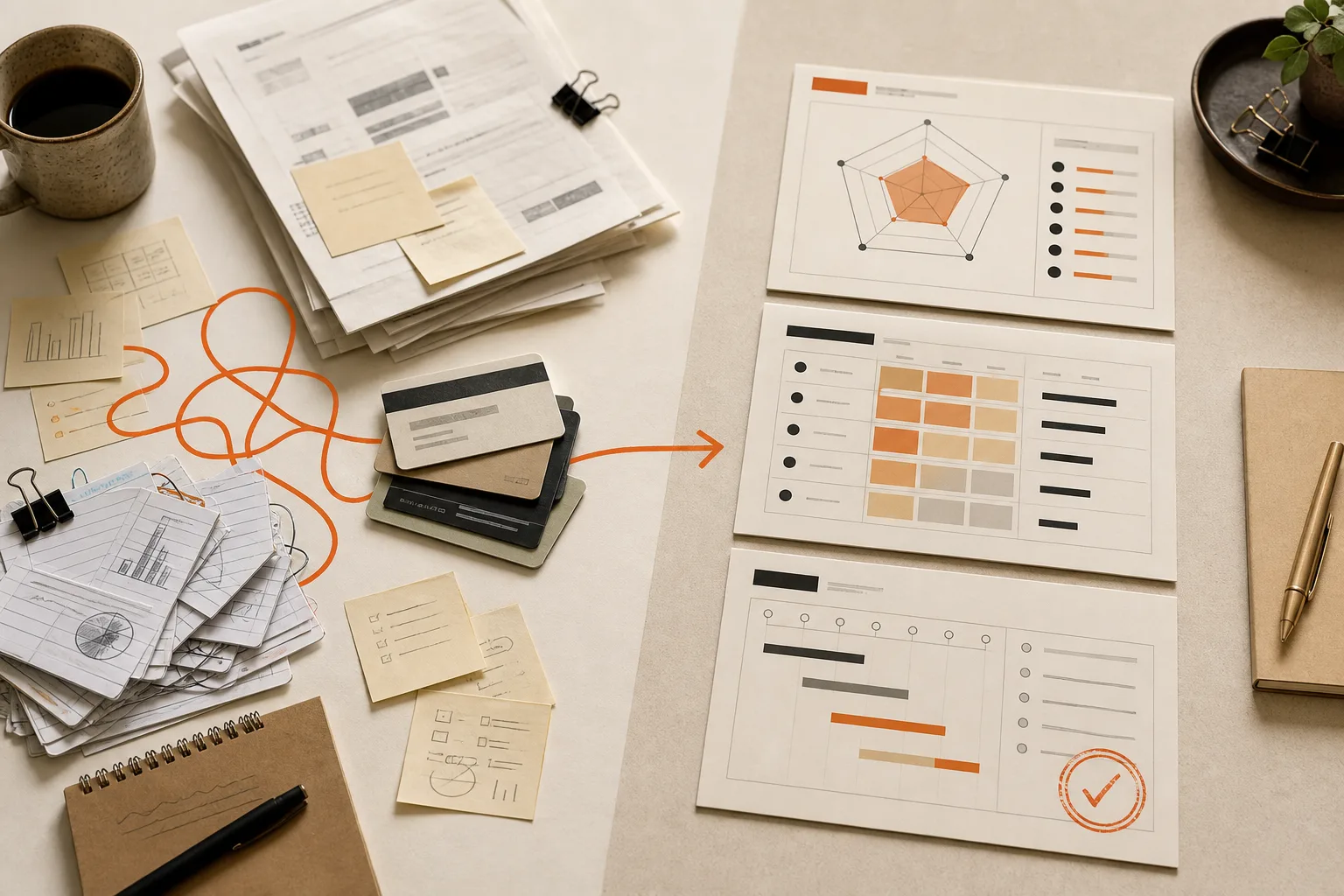
The output is not a catalog of possible AI use cases. It is a prioritized recommendation tied to your people, systems, constraints, and recurring work.
Who it is for
Especially useful before you
When not to buy it
Actively disqualifying poor fits protects your time and ours. If one of these describes you, an Executive Session, a Workflow Upgrade, or a different conversation is usually the better start.
What you receive
A concise explanation of what leadership should do now, defer, avoid, and measure.
2–4 pages
A scorecard covering current use, repeatability, leadership visibility, review practices, data boundaries, measurement, and ownership.
Supports discussion, not scientific certification
A practical map of AI capability already available in your current software and subscriptions—by tool, users, features, workflows, data concerns, and keep/expand/test/stop.
A prioritized matrix of recurring work by role, current burden, candidate method, expected benefit, human-review point, data sensitivity, and recommended next step.
Plain-language rules for what information may be used, what requires additional controls, what outputs require verification, and what actions remain human-approved.
Engagement guidance, not a compliance certification
A practical view of where a faster or lower-cost competitor could create pressure through better research, drafting, response, reporting, or coordination.
A sequenced plan with a small number of useful experiments, named owners, success measures, and decision points.
Normally no more than three primary experiments at once
A clear recommendation—proceed independently, run an Executive Session, launch a 30-Day Program, upgrade one workflow, investigate a custom build, establish fractional support, or do nothing yet.
“Do nothing yet” remains a legitimate outcome
Sample outputs
An illustrative, operationally realistic sample based on a company archetype. Clearly labeled as an example—not a real client report.
Illustrative: 35-person professional-services firm
Executive summary
Maturity baseline
Workflow opportunity matrix
Human-review & data boundaries
30-day plan
Illustrative example. A downloadable sample report can be provided on request; opens are measured as a conversion-assist event, not gated behind a form.
How the Review works
Before
During
After
Recommended standard cadence
This is a proposed operating model, confirmed against delivery capacity. Timelines are described as “typical” and scope is defined in writing.
What Jason needs from you
The Review does not require unrestricted access to company systems. Access and examples are minimized to what is necessary, and sensitive-data handling is agreed before work begins.
Scope
Scope, deliverables, and price are set in a short written document before work begins—no surprises, no open-ended billing.
Price is affected by
These are proposed examples, not rigid packages. Scope follows the work.
Risks, boundaries, and what is not included
The purpose is to make the next decision smaller, clearer, and better supported—not to pretend that every uncertainty disappears.
Why The Tomorrow Machine
You work directly with Jason Merkoski from kickoff through the leadership readout. Jason combines an MIT education, early Amazon product leadership, long experience as a CTO and builder, and current hands-on work across ChatGPT, Claude, voice AI, supervised browser automation, integrations, and production systems.
That breadth matters in a Readiness Review because the recommendation does not have to force every problem into a workshop, one software vendor, or a custom build.
FAQ
No. The Review may include demonstrations, but the product is a practical assessment and action plan tied to real recurring work.
No. Tool selection follows the workflow, data, controls, cost, and fit.
Yes, where those products are relevant to your current licenses and work.
Potentially, with explicit decisions about access, vendors, storage, logging, agreements, and human review. Sensitive examples can often be minimized or sanitized during assessment.
Yes. One purpose of the Review is to separate needs that can be handled through better methods or configuration from those that may justify integration or custom development.
You may execute the plan independently, run a 30-Day Program, upgrade one workflow, commission a qualified build, or use fractional support. No follow-on engagement is required.
A useful initial estimate is one kickoff, selected interviews or working sessions, light material gathering, and a leadership readout.
The Executive Session is better for a focused leadership question or first experiment. The Review is broader and produces a company-specific baseline, opportunity map, boundaries, and 30-day plan.
After a short conversation, we define scope, deliverables, and a fixed price in writing before any work begins. Scope depends on roles, workflows, systems, data constraints, and delivery format.
Where this can lead
A smaller, lower-friction alternative when you have one focused leadership question.
See the Executive SessionThe likely next step once roles and workflows are chosen and you want measurable adoption.
See the 30-Day ProgramWhen one recurring workflow is already understood and worth improving now.
See the Workflow UpgradeDiscuss a Readiness Review
Bring the recurring work, tools, or competitive pressure on your mind. We will determine whether a Readiness Review is the right first step and define the smallest useful scope.
Free AI Strategy Conversation · No sales team · You speak directly with Jason
Prefer email? Reach Jason directly at hello@tomorrowmachine.ai.
Based in Santa Fe, New Mexico. U.S. Mountain and Pacific working hours.
Pick a time for a free 30-minute AI Strategy Conversation. Bring the business problem on your mind—you will leave with an honest point of view on where AI can create the most value, and your best next move.
What happens on the conversation
Useful to bring